
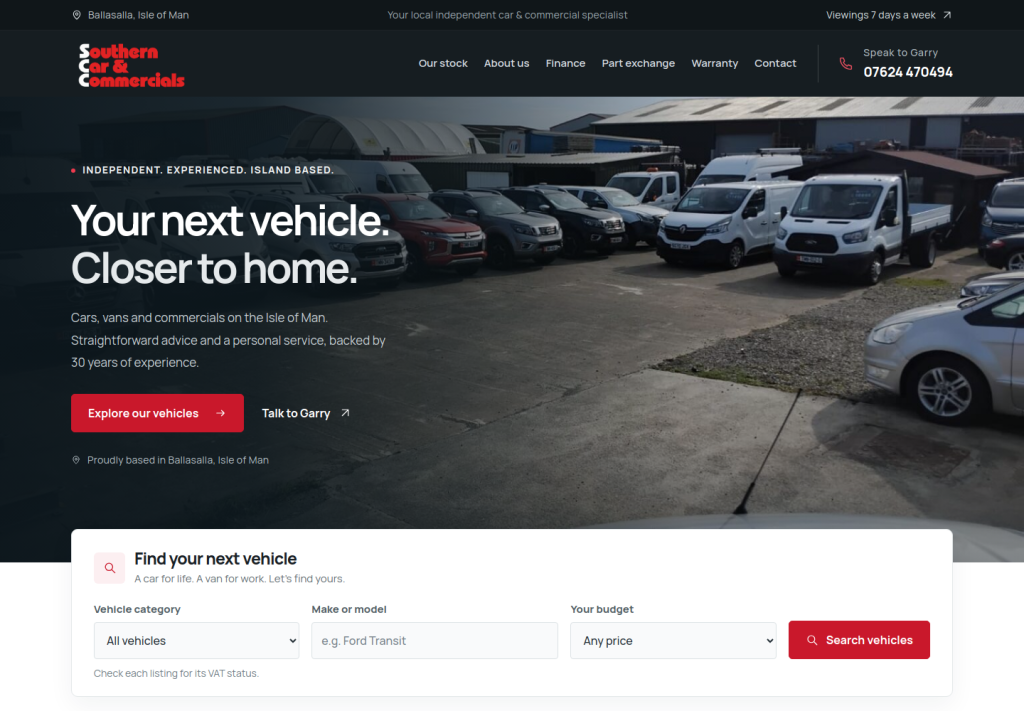

A website built for real customer decisions in High Street
Businesses serving a community such as High Street often work across several nearby places rather than within one boundary. Web Professionals builds and manages websites for businesses serving High Street and the wider Cornwall area.
Good design needs to do more than make the company look polished. That means making the main services, genuine proof and practical coverage easy to find. The result should feel like a real business website for customers around High Street, with clear information that helps them decide what to do next.
Local context around High Street
High Street sits close to Carloggas (about 0.8 miles away in a straight line, to the north-west), Hendra (about 0.9 miles away in a straight line, to the south) and Nanpean (about 1.7 miles away in a straight line, to the north). Those nearby communities help give a practical picture of the wider area a local business may serve; the distances shown are approximate straight-line distances rather than driving times.
Nearby-place information is most useful when it helps customers understand where a business genuinely works. If customers genuinely come from Carloggas, Hendra, Nanpean and Saint Stephen, the website can explain that wider coverage clearly and naturally. Accuracy matters more than adding unsupported local claims.
Make future improvements easier to add
New services, stronger project evidence and changing priorities are normal as a business develops. Starting with clear core pages makes later improvements easier to organise and measure. That approach gives a business serving High Street flexibility without adding content that customers do not need.
Use service pages as useful decision pages
Customers usually want to understand what is included, who the service is for and what happens next. Useful detail can cover the process, common questions, relevant proof and any constraints a customer should know before enquiring. It also gives a High Street business clearer places to explain each service, show relevant work and answer customer questions.
- Customer questions: Answer the practical questions that commonly delay an enquiry or quote request.
- Real proof: Use genuine projects, reviews, credentials or business evidence where they support a decision.
- Clear next steps: Show what a customer should do after reading enough to decide the business may be suitable.
- Local visibility: Organise services and useful content clearly so customers can find the right information quickly.
For the wider offer, see the web design service, compare managed website packages and review real client projects.
Build around the questions customers ask first
People often scan a business website before deciding whether to spend more time on it. The customer journey works best when each section has a reason to exist rather than simply filling vertical space. A High Street business can use that journey to support calls, WhatsApp messages, quote forms or appointment requests according to how it actually sells.
Make the website useful before adding ongoing SEO
Search visibility is more valuable when visitors arrive on a page that actually helps them make a decision. Real customer questions, project examples and service details can be added as the business develops. The result is a website that helps customers around High Street understand the offer and gives the business room to build visibility over time.
Businesses that want ongoing optimisation can also review Local SEO and SEO Pro. Those services build on the website rather than replacing the need for useful service content and genuine business proof.
Explain coverage clearly for customers around High Street
A clear service area can help people decide quickly whether it is worth getting in touch. Around High Street, places such as Carloggas, Hendra, Nanpean and Saint Stephen help show the practical local catchment. Clear coverage information can reduce unnecessary enquiries from outside the practical service area.
Build the first version around the services that matter most
The setup process should begin with real business information rather than filler copy. Start with the offer, the evidence behind it and the real contact or quotation process. That gives a website serving High Street a useful foundation that can become more specific as the business learns which services and customer questions matter most.