
A website built for real customer decisions in Rhiw-lâs
Businesses around Rhiw-lâs may depend on a wider practical catchment, so the website should explain coverage naturally rather than pretending the village is the only market. Web Professionals builds and manages websites for businesses serving Rhiw-lâs and the wider Monmouthshire area.
The website should answer the questions that normally sit between discovery and an enquiry. Service information, project evidence and calls to action need to work together rather than compete for attention. The result should feel like a real business website for customers around Rhiw-lâs, with clear information that helps them decide what to do next.
How Rhiw-lâs connects with the surrounding area
Rhiw-lâs sits close to Usk (about 4.0 miles away in a straight line, to the south), Abergavenny (about 7.0 miles away in a straight line, to the north-west) and Pontypool (about 7.9 miles away in a straight line, to the south-west). Those nearby communities help give a practical picture of the wider area a local business may serve; the distances shown are approximate straight-line distances rather than driving times.
A clear service-area section can make it easier for customers to see whether the business covers their location. Businesses can explain work across Usk, Abergavenny, Pontypool and Monmouth where that reflects their real customer base. The aim is simply to make service coverage clear and useful for the customer.
Make credibility visible throughout the website
Claims such as reliable, trusted or high quality are stronger when the website shows why they are credible. A consistent company identity, accurate contact information and visible process detail also help the business feel established. For customers around Rhiw-lâs, real proof can bridge the gap between finding a business online and feeling confident enough to make contact.
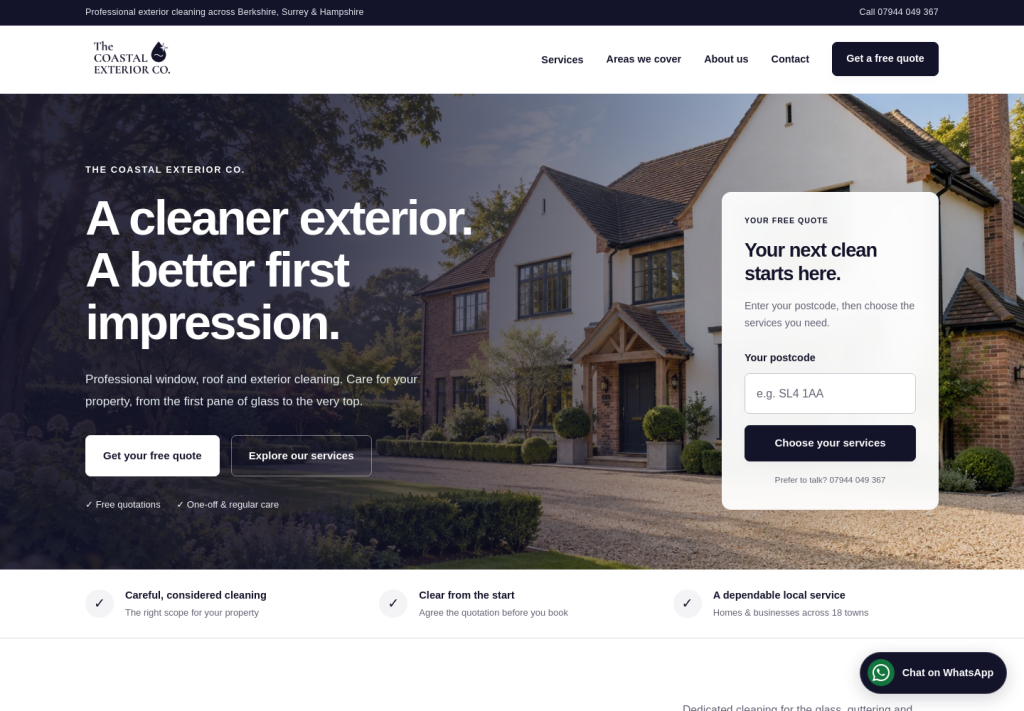
Portfolio examples elsewhere on this website are genuine Web Professionals projects. They are shown as general evidence unless a project genuinely belongs to Rhiw-lâs, so the page does not need fabricated local clients or testimonials.
Connect Rhiw-lâs with nearby communities customers recognise
Customers often want to know whether a company covers their area before spending time on the rest of the website. The local map and nearby places give customers a simple view of Rhiw-lâs in relation to surrounding communities. That helps people understand the service area while keeping the information practical and accurate.
Keep the mobile journey practical
Phone users need the same confidence-building information as desktop visitors, but the order and spacing matter more. Readable text, comfortable controls, stable layouts and obvious call or message options all contribute to a smoother experience. This matters whether the visitor discovered the business through Google, a recommendation or a shared link around Rhiw-lâs.
Give each important service enough room to be useful
A service page is most useful when it answers practical questions instead of repeating promotional claims. Clear service boundaries also make it easier to add supporting content later without rebuilding the whole website. That is especially useful when customers in Rhiw-lâs may be comparing several different services or packages.
- Accurate business details: Keep company identity, contact information and trust details consistent across the site.
- Mobile enquiries: Keep calls, messages, quote requests and forms comfortable to use on smaller screens.
- Coverage: Explain the places genuinely served without implying offices or branches that do not exist.
- Maintainable structure: Leave logical room for stronger project content, new services and useful guides later.
For the wider offer, see the web design service, compare managed website packages and review real client projects.
Leave room for the website to grow with the business
Good structure gives the business somewhere logical to put new content later. Content should be able to expand without turning navigation into an unplanned list of pages. The result is a site that can become more useful as the business learns which services, questions and areas matter most to customers.
Start with the strongest information you already have
There is no benefit in inventing extra pages before the core customer journey is clear. Gather the services that generate work, the questions prospects ask, the proof available and the places the business genuinely serves. That gives the Rhiw-lâs section a clear role within the wider website and a useful purpose for customers who want to understand the service and coverage.